Service FileDossier de Service
- Reg. No.Matricule 10535
- BornNé May 7, 1907, Saanichton, British Columbia7 mai 1907, Saanichton, Colombie-Britannique
- Engaged, RCMPEngagé, GRC January 26, 192926 janvier 1929
- DivisionsDivisions Saskatchewan and British ColumbiaSaskatchewan et Colombie-Britannique
- Discharged, RCMPLibéré, GRC January 25, 193325 janvier 1933
- Later ServiceService Ultérieur Canadian Army, Princess Patricia's Canadian Light Infantry (PPCLI), 1940–1945, overseasArmée canadienne, Princess Patricia's Canadian Light Infantry (PPCLI), 1940–1945, outre-mer
- DiedDécédé 1995, aged 871995, à l’âge de 87 ans
- BuriedInhumé Royal Oak Burial Park, Victoria, BCRoyal Oak Burial Park, Victoria, C.-B.
- SourcesSources The Daily Colonist, 22 Apr. 1964, p.1; 30 Sept. 1968, p.26 — The Times Colonist, 4 Jan. 1995, p. D4The Daily Colonist, 22 avril 1964, p.1; 30 sept. 1968, p.26 — The Times Colonist, 4 janv. 1995, p. D4
Two Uniforms, One Life of Service
He came from the land itself — born within sight and smell of the Saanich Peninsula's farms and inlets, in the year 1907, in a corner of Vancouver Island that was still more orchard and farmhouse than town…
Joseph Henderson Armstrong grew up in Saanichton, a settlement of quiet fields and salt air not far from the provincial capital. Little is recorded of his boyhood there, but it was a young man of not yet twenty-two who presented himself for engagement in the RCMP on January 26, 1929, taking Regimental Number 10535 into a Force still finding its modern footing only a few years after the merger of the old Royal North-West Mounted Police with the Dominion Police.
His four years of service carried him through postings in Saskatchewan and British Columbia, the two provinces bookending each other on either side of the Rockies, both familiar ground and yet both demanding of a young constable in the difficult early years of the Depression.
Two small stories from those early years have survived, courtesy of RCMP Veteran and historian Jack White. In 1929, while posted to night guard duty at the Receiver General's Office in Regina, the young constable heard scratching at a window and, in the poor light, took what he saw for a man's arm working to force an entry. Forbidden to leave his post, he fired his revolver through the glass and telephoned the city police to report a break-in underway. They arrived to find not a burglar but a dead cat.
That same year, assigned to a string of grain thefts, Armstrong found a simpler solution than the usual legwork: he mixed coloured confetti into sacks of wheat in the fields being targeted. When stolen wheat later turned up carrying the same telltale colour, he had all the evidence he needed.
He was discharged on January 25, 1933, his first chapter of service closed, though far from his last.
What filled the years immediately after his RCMP discharge is not yet part of the documented record available to us, but by 1940 Armstrong had answered a second call. He enlisted in the Canadian Army and joined the ranks of the Princess Patricia's Canadian Light Infantry, one of the country's storied infantry regiments, serving overseas from 1940 until 1945. It was the regiment that would carry Canadian soldiers through the Sicilian landings, the long and costly Italian campaign, and finally into the Netherlands in the last months of the war — the broader story of the unit he wore the badge of for five years of his life, half a world from the Saanich fields where he'd been born.
By the 1960s, Armstrong's name had found its way into the pages of the Daily Colonist on at least two occasions, in April 1964 and again in September 1968 — brief windows onto a long postwar life in and around Victoria that still await fuller research. What is certain is that he lived on for exactly fifty years after the guns fell silent in Europe, long enough to see the century turn twice over in its own way, from horseback patrol to jet travel, from the King's Mounted Police to a modern Force he would scarcely have recognized in his youth.
Joseph Henderson Armstrong died in 1995 at the age of eighty-seven. He is buried at Royal Oak Burial Park in Victoria, not far from the peninsula where he was born, under a small bronze marker that gives only his name and his years — a modest closing line for a man who wore two uniforms and answered two calls to service, thirty-five years apart.
Deux Uniformes, Une Vie de Service
Il venait de cette terre même — né à portée de vue et d’odeur des fermes et des baies de la péninsule de Saanich, en l’an 1907, dans un coin de l’île de Vancouver encore davantage verger et ferme que ville…
Joseph Henderson Armstrong a grandi à Saanichton, un village de champs tranquilles et d’air salin non loin de la capitale provinciale. Peu de choses sont consignées sur son enfance là-bas, mais c’est un jeune homme de pas encore vingt-deux ans qui se présenta pour s’engager dans la GRC le 26 janvier 1929, portant le matricule 10535 dans une Force qui trouvait encore ses repères modernes, quelques années seulement après la fusion de l’ancienne Police royale à cheval du Nord-Ouest avec la Police du Dominion.
Ses quatre années de service l’ont mené à des affectations en Saskatchewan et en Colombie-Britannique, deux provinces qui s’encadrent de part et d’autre des Rocheuses, terrain à la fois familier et exigeant pour un jeune gendarme durant les années difficiles du début de la Dépression.
Deux petites anecdotes de ces premières années nous sont parvenues, grâce au Vétéran GRC et historien Jack White. En 1929, alors qu’il était affecté à la garde de nuit au bureau du Receveur général à Regina, le jeune gendarme entendit des grattements à une fenêtre et, dans la faible lumière, crut voir un bras d’homme tentant de forcer une entrée. N’ayant pas le droit de quitter son poste, il tira à travers la vitre avec son revolver, puis téléphona à la police municipale pour signaler une tentative d’effraction en cours. Les policiers arrivèrent pour découvrir, non pas un cambrioleur, mais un chat mort.
Cette même année, chargé d’enquêter sur une série de vols de blé, Armstrong trouva une solution plus simple que le travail de terrain habituel : il mélangea des confettis colorés dans les sacs de blé des champs visés. Lorsque du blé volé fut plus tard retrouvé portant cette même couleur révélatrice, il avait toute la preuve dont il avait besoin.
Il fut libéré le 25 janvier 1933, refermant ainsi le premier chapitre de son service, mais non le dernier.
Ce qui a rempli les années suivant immédiatement sa libération de la GRC ne fait pas encore partie du dossier documenté dont nous disposons, mais en 1940, Armstrong avait répondu à un second appel. Il s’enrôla dans l’Armée canadienne et rejoignit les rangs du Princess Patricia’s Canadian Light Infantry, l’un des régiments d’infanterie les plus célèbres du pays, servant outre-mer de 1940 à 1945. C’est ce régiment qui allait porter les soldats canadiens à travers les débarquements en Sicile, la longue et coûteuse campagne d’Italie, et enfin jusqu’aux Pays-Bas dans les derniers mois de la guerre — l’histoire plus large de l’unité dont il porta l’insigne pendant cinq années de sa vie, à l’autre bout du monde des champs de Saanich où il était né.
Dans les années 1960, le nom d’Armstrong avait trouvé sa place dans les pages du Daily Colonist à au moins deux reprises, en avril 1964 puis à nouveau en septembre 1968 — de brèves fenêtres sur une longue vie d’après-guerre à Victoria et dans ses environs, qui attendent encore des recherches plus approfondies. Ce qui est certain, c’est qu’il a vécu exactement cinquante ans après que les armes se soient tues en Europe, assez longtemps pour voir le siècle tourner deux fois sur lui-même, de la patrouille à cheval au voyage en jet, de la Police montée du Roi à une Force moderne qu’il aurait à peine reconnue dans sa jeunesse.
Joseph Henderson Armstrong est décédé en 1995 à l’âge de quatre-vingt-sept ans. Il repose au Royal Oak Burial Park à Victoria, non loin de la péninsule où il est né, sous une petite plaque de bronze qui ne porte que son nom et ses années — une ligne de clôture modeste pour un homme qui a porté deux uniformes et répondu à deux appels au service, à trente-cinq ans d’intervalle.
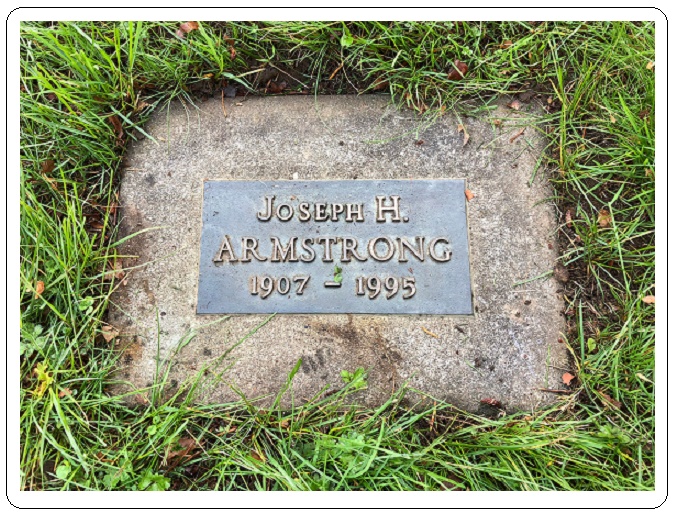
Royal Oak Burial Park · Victoria, BC Royal Oak Burial Park · Victoria, C.-B.
Constable Joseph Henderson Armstrong · 1907–1995 · RCMP & PPCLI, Canadian Army · R.I.P. Gendarme Joseph Henderson Armstrong · 1907–1995 · GRC et PPCLI, Armée canadienne · R.I.P.
This story was composed from Constable Armstrong's confirmed RCMP and PPCLI service dates, his grave marker at Royal Oak Burial Park, the recollection of a Force volunteer regarding his overseas war service, and two anecdotes preserved courtesy of RCMP Veteran and historian Jack White. The Daily Colonist (22 April 1964, p.1; 30 September 1968, p.26) and Times Colonist (4 January 1995, p. D4) references are believed to hold further biographical detail not yet incorporated here, pending fuller research. Photo of Constable Armstrong's grave courtesy of photographer “Anne S” and Find A Grave, and Merle Armstrong, RCMP Vets London, ON. Cette histoire a été composée à partir des dates de service confirmées du gendarme Armstrong à la GRC et au PPCLI, de sa plaque tombale au Royal Oak Burial Park, du souvenir d’un bénévole de la Force concernant son service de guerre outre-mer, et de deux anecdotes préservées grâce au Vétéran GRC et historien Jack White. Les références du Daily Colonist (22 avril 1964, p.1; 30 septembre 1968, p.26) et du Times Colonist (4 janvier 1995, p. D4) renfermeraient vraisemblablement des détails biographiques supplémentaires non encore intégrés ici, en attendant des recherches plus approfondies. Photo de la tombe du gendarme Armstrong gracieuseté de la photographe « Anne S » et de Find A Grave, ainsi que de Merle Armstrong, Vétérans de la GRC, London, ON.
Structure & Drafting Assistance: Claude AI (Anthropic) Structure et Rédaction Assistée : Claude AI (Anthropic)