


True and Fascinating Canadian History
A Tribute:
The Importance of Honouring the Dead
by J. J. Healy
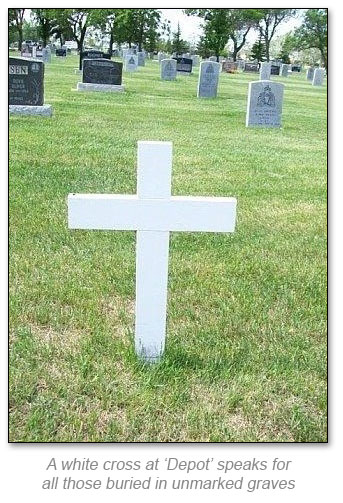
Down through time people in every culture have looked after their dead in a special way. Even the earliest communities left evidence of the care given to family members who had died.
Our human nature calls us to pay respect to the dead. He or she is gone, it is our loss. We honour those who have passed before us by being sensitive to the rituals of burial and by being mindful of tending to the graves of the deceased.
The Neanderthals of 130,000 years ago placed flowers in graves and often a grave site was dug into the floor of the cave where the family lived so as to keep a dead loved one within the family circle.
Everyone is aware of the extent to which early Egyptians prepared the bodies of their dead for the afterlife. Remarkable preservation techniques, elaborate burial tombs and great riches reveal the degree to which this ancient society honoured the dead.
In the timeless tale of The Iliad, Aias risked his own life to retrieve the lifeless body of Patroclus, so that the slain solider could receive an honourable burial. Ancient Greek society also offers many examples of the human need to respect the dead. Today, soldiers are brought home to be buried when they have been killed in some place around the world. The human heart mysteriously calls out for the deceased to come home.
Christians are taught the story of Jesus and His crucifixion. After His death on the cross, it became very important to prepare the body and lay Christ’s body in a tomb before the Sabbath in accordance with Jewish tradition. Certainly every religious group throughout all time enacts important burial rituals that reflect the human need to pay homage to the dead.
As a modern people, we continue to give our dead special honour. As Canadians, we are now becoming accustomed to seeing dead soldiers returned home from the battlefield. Special ceremonies are held to receive the body at the airport and high level dignitaries are present to pay their respects to the deceased and to the family. Later on, a church service may be held and the deceased soldier is remembered and eulogized in a special way as the sacrifice made by soldier is recognized. The deceased soldier’s friends wear their uniforms and a public parade is customarily held.
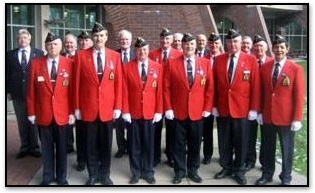
This unique and memorable military funeral protocol is not unlike the service held for Canadian police officers who die or are killed on duty. The protocol which is about to be described might also be followed by police services in other countries around the world.
In Canada, the death of a police officer is a very public tragedy. TV and the media publicize the death and the entire country mourns the loss. Members of all communities can be heard talking about the sudden death of a Canadian police officer. Usually special mention of the officer is pronounced in the House of Commons by the Prime Minister.
Quite often high government officials will call the family of the deceased to express their sorrow over the tragedy and to offer compassion and condolences. A marked police car is usually placed near the family home over the mourning period to show solidarity and respect to the family of the deceased member. Other police officers from across Canada and from America and other countries travel to the place of the funeral to pay their respects and to participate in the funeral rites and parade.
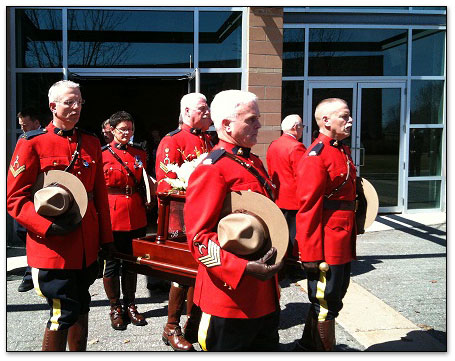
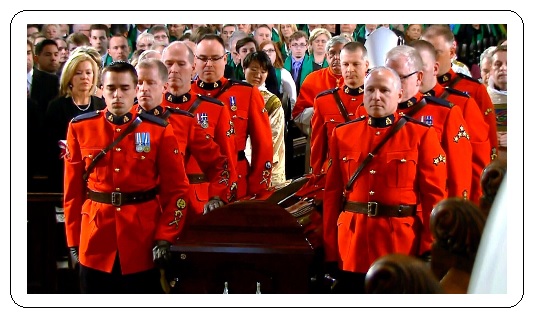
Other police officers and friends attend the funeral home and sign a book of condolences. They usually pay their respects to the deceased as well as to the family of the fallen police officer. The deceased police officer is customarily buried in Red Serge – a public sign that he or she was a member of a very elite group of Canadian police officers.
Planning for the funeral may take several days and involve the coordination of hundreds of persons. A special venue site is required to comfortably hold all the guests and visiting dignitaries. The Commissioner and Senior Officers of the Force attend the funeral service. Friends of the deceased who participate in the service are instructed about funeral protocols. Other police officers are assigned to pay particular care of the family.
A parade of several hundred police officers follows a pre-designed route to the church. Pipe bands provide the music for the police parade and this adds more solemnity. Other special arrangements are made and care is provided in the parade if the fallen police officer belonged to a special group within the police family such as a Pilot, a Motorcycle Officer or a Dog Master.
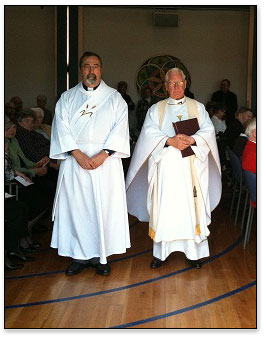
The Police Chaplain may have special concerns about the liturgy of the service and he or she will provide instructions to the police officers or others who participate in the funeral rite.
On the day of the funeral, strict protocols are followed. Funeral procedures are written out in instructional manuals and each police officer who participates in the church service or the public ceremony plays a special role. The police officer’s casket is covered with the Canadian flag.
A large portrait of the deceased member may be placed near the casket inside the church. Troop mates are assigned to carry the Stetson of the deceased and others volunteer to speak on behalf of the Force at the funeral. On top of the casket will rest the Stetson and Sam Brown belt attire of the deceased.
After the service, a post funeral parade continues back to a place where the family of the deceased meets friends and shares events in the life of the deceased.
In summary, police officers hold a unique place of trust and respect within Canadian society. It comes not as a
surprise, therefore, that when a police officer dies he or she is paid special respect and honour and the funeral
service is conducted with tradition and ceremony.